The 64% Tariff Cut: An Economic Masterstroke or Just Another Geopolitical Gimmick?
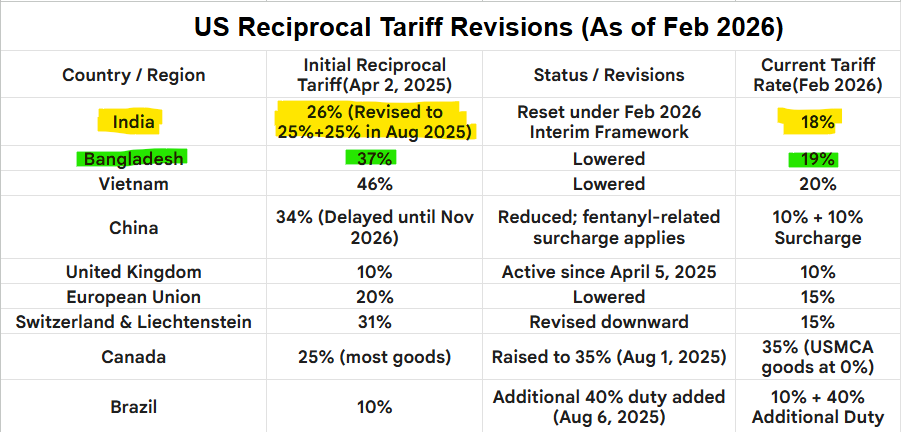
Let’s be real: we know Mr. Trump loves his tariffs. To him, it’s not just a policy; it’s his “favorite word”, a magic wand he believes makes America “rich.” And we certainly felt that love last year when duties spiked from 26% in April 2025 all the way to a punishing 50% by August.
But as of February 9, 2026, the script has flipped.
Now, suddenly, we have a new framework on the table. A 64% reduction. A flat 18% rate. It sounds generous. But before we start celebrating, we need to look closer. Is this actually a substantive stimulus for our economy, or is it just optics disguised as policy another way to make America “rich”?
The Breakdown of the Feb 2026 “Interim Trade Agreement”
To understand the deal, we have to look at the math of the penalty box we just escaped.
Until this week, the tariff rate on Indian goods stood at 50%. But this figure was actually a split bill. It was structured as a 25% base tariff plus another 25% slammed as a penalty for our trade with Russia during the Ukraine war. It was effectively a fine for buying “forbidden” oil.
Now, what has changed is that because of the new agreement where India will eventually reduce imports from Russia the earlier 25% penalty has vanished. But the penalty didn’t just disappear; it was bought. And the price we paid is buried in the fine print.
Hidden Parameters
The trade deal suggests that India “intends” to achieve imports from the US worth $500 billion over the next five years. This includes massive purchases of US Crude Oil & LNG, Boeing Aircraft, and Defense Hardware.
This $500 billion is the hidden price tag for our tariff reduction.
The deal effectively mandates $100 billion of imports annually. To put that in perspective, in FY 2024-25, India imported only ~$45.62 billion of US goods while exporting ~$86.51 billion. We are currently Net Positive. But under this new mandate, we could swing to a massive Net Loss of ~$54.38 billion.
Furthermore, many US products now have the benefit of a Zero Rate, including specific US ICTE (Tech Hardware) and Industrial Goods. This directly contradicts the statement of PM Narendra Modi, who said, “This trade would lead to the growth of Make in India.”
How can “Make in India” thrive when we are actively inviting the world’s biggest manufacturer to compete duty-free in our own backyard? We are essentially importing American competition to keep American tariffs at bay.
The Bangladesh Curveball
But the friction didn’t stop there. Just as the balance sheet was made public, and Indian traders in the leather and textile market began to breathe a sigh of relief, came another punch from the US.
On February 10, Washington slashed the reciprocal duty on Bangladeshi goods to 19% dangerously close to India’s 18%.
But the real blow was buried in the fine print: a conditional 0% tariff for apparel made from US-grown cotton or fibers. This ‘poison pill’ effectively neutralizes India’s tariff advantage by incentivizing Dhaka to swap Indian raw materials for American ones to unlock duty-free access.
The Currency Cost
Committing to import $100 billion worth of US goods annually isn’t just a trade promise; it’s a forex nightmare. To buy American oil, planes, and machinery, we need US Dollars.
A sudden, sustained demand for $100 billion creates immense pressure on the Rupee. We might have saved our exporters from a 50% tariff, but if the Rupee depreciates due to this dollar outflow, the cost of everything else in the economy goes up.
We are effectively importing American inflation.
Trade for Both Countries: The Balance Sheet
So, what exactly was swapped? Here is the ledger of the deal:
What India Gets (The 18% Club)
- Tariff Reduction: Duties slashed to 18% for labor-intensive sectors like Textiles, Leather, and Apparel (down from 50%).
- Zero-Duty Access:
- Generic Pharmaceuticals: A massive win for our drug makers (subject to FDA approval).
- Gems & Jewelry: Zero duty on cut and polished diamonds.
- Aircraft Parts: A boost for our aerospace supply chain.
What the US Gets (The Entry Fee)
- The $500bn Intent: A commitment to buy US Energy (LNG/Oil), Civil Aviation (Boeing), and Defense equipment.
- Agriculture: Market access for US Almonds, Walnuts, Apples, and Berries (hurting our farmers in Himachal and Kashmir).
- Technology: Removal of import licensing restrictions on US laptops, servers, and ICT hardware.
- Industrial Goods: Duty-free entry for a wide range of US heavy machinery.
The Verdict: A Ransom Note Disguised as a Deal?
So, did we win?
If you look strictly at the tariff sheet, yes. Coming down from 50% to 18% is a relief for our exporters. But let’s not mistake relief for victory. This wasn’t a negotiation of equals; it was a corrective maneuver.
We didn’t win a ‘free trade’ deal; we signed a massive purchase order.
We escaped the penalty box by agreeing to shop exclusively at the American mall trading cheap Russian oil for expensive American LNG and swapping ‘Make in India’ for ‘Buy American’ in critical sectors.
The 64% cut is a great headline. But when you factor in the $500 billion bill, the zero-tariff loop for Bangladesh, and the hit to our strategic autonomy, it becomes clear: We didn’t get a discount.
We just agreed to pay the full price upfront.
Sources
Subscribe to Economic Frictions
Get independent analysis delivered to your inbox.
Instant unsubscribe link included in every email.
Secure Subscription • One-Click Unsubscribe