If Inflation Is Under Control, Why Does Everything Still Feel Expensive?
Let’s start with what inflation actually means not in textbook language, but in everyday life.
Inflation is the general increase in the price level of common goods and services, which indirectly means a reduction in the real value of money over time. Simply put, the same amount of money buys less than it did earlier.
So, what does “inflation under control” mean? How is it interpreted by a common man? And most importantly, even after inflation is claimed to be under control, why does everything still feel expensive?
What is “inflation under control”?
Inflation under control does not mean that there is a reduction in prices of goods and services. Rather, it means that the central bank or government is successfully managing the rate at which prices rise, keeping it low and relatively stable.
How is “inflation under control” interpreted by a common man in India?
For a common man in India, inflation under control has little to do with CPI data or official statements from the Reserve Bank of India. It simply means life feels stable.
If grocery bills do not keep increasing every month, rent hikes are predictable, fuel prices remain steady, and school or medical expenses do not create panic, inflation feels under control.
However, when expenses rise faster than income, or when savings are exhausted just to maintain the same lifestyle, inflation does not feel under control to the common man, regardless of what the numbers suggest.
Why Does Everything Still Feel Expensive?
The Ratchet Effect
Even when the inflation rate slows down, prices in the economy rarely fall. Prices are downward-sticky, meaning once a higher price becomes normal in the market, it tends to stay there. As a result, inflation may decline, but the price level remains elevated, making goods continue to feel expensive.
Shrinkflation
In many cases, prices do not increase visibly. Instead, the quantity or size of the product is reduced while the price remains the same. This hidden form of inflation raises the cost per unit and places a continuous burden on regular consumers.
Controlled Inflation
Controlled inflation is often misunderstood at the household level. While policymakers may view an inflation rate of 4–6 percent as acceptable for a developing economy, its impact is felt immediately in daily expenses. Even moderate inflation translates into higher monthly outflows, making it feel significantly heavier for individuals.
Raw Material Costs
Over time, raw material prices tend to rise due to factors such as energy costs, supply chain constraints, and global price movements. When inflation adds to these rising input costs, the final prices of goods and services increase further, compounding the burden on consumers.
Wage Growth vs Inflation
Inflation is reflected in prices almost instantly, whereas wage growth is slower and often delayed. This wage-lag effect temporarily reduces purchasing power, and during this period, households feel the pressure of rising prices most strongly.
GDP Growth vs Population Growth vs Consumer Food Price Index (CFPI)
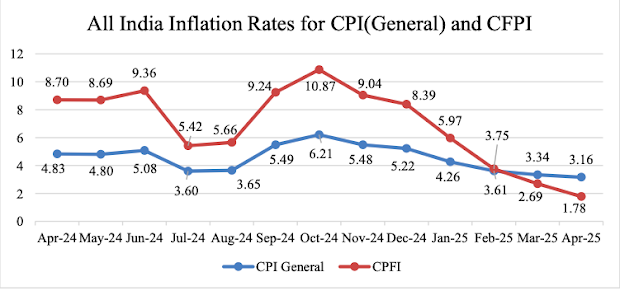
The fiscal year 2024–25 recorded strong nominal GDP growth along with population growth of less than 1 percent. However, data from the Ministry of Statistics and Programme Implementation shows that while average CPI inflation remained around 4–5 percent, food inflation (CFPI) was significantly higher, close to 7–8 percent.
This gap is large enough to create visible stress for middle-income households. Food is a necessity consumed by every individual, irrespective of income or status, and its inflation impacts households immediately. At the same time, GDP growth is not distributed evenly across the population.
Since CPI includes several non-essential items with lower inflation, it often understates the actual cost pressure faced by households. This explains why inflation feels much higher than what headline numbers suggest.
Final Thought
Inflation may be under control statistically, but for households, what truly matters is whether life feels affordable. When essential expenses rise faster than incomes, when prices do not fall back, and when economic growth does not reach everyone equally, inflation continues to feel real even if the numbers say otherwise.
Subscribe to Economic Frictions
Get independent analysis delivered to your inbox.
Instant unsubscribe link included in every email.
Secure Subscription • One-Click Unsubscribe