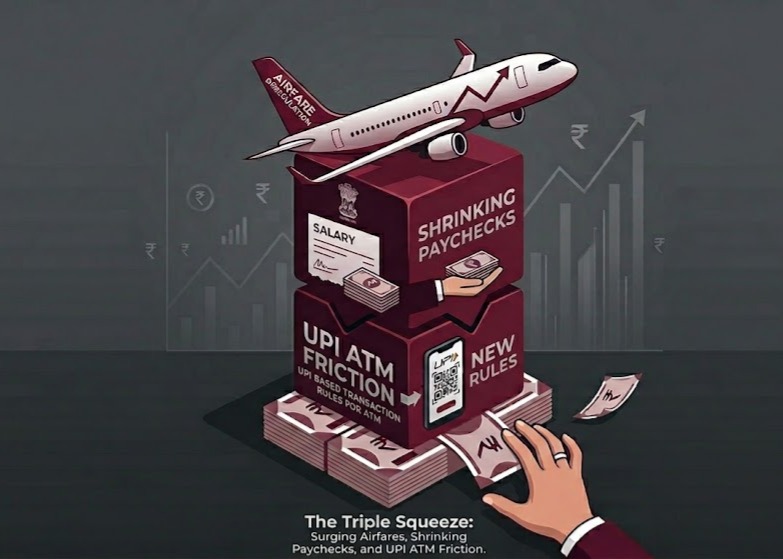
The Triple Squeeze: Surging Airfares, Shrinking Paychecks, and UPI ATM Friction
If you feel like your bank account is draining faster this month, you are not imagining things.
The math is actively working against you.
For the past few weeks, headlines have focused on geopolitics and crude oil. But the real macroeconomic shock is not in the news cycle. It is happening directly inside your wallet.
As of late March 2026, the salaried middle class is absorbing a perfectly timed triple squeeze.
Flight prices are deregulated.
Take home pay is shrinking.
Physical cash is trapped behind digital friction.
None of these three pressures is accidental. Each one is the product of a deliberate policy decision. Each one is defensible in isolation.
Together, they are compressing middle class liquidity at exactly the wrong moment.
The Mobility Premium: The End of Fare Caps
Aviation Turbine Fuel accounts for nearly 40 percent of an airline’s operating cost. It is the single largest variable on an airline’s balance sheet. When global energy markets move, that number moves first.
But the deeper shock came from policy, not oil.
The Ministry of Civil Aviation officially removed all temporary domestic airfare caps. The decision handed airlines complete pricing freedom at the precise moment fuel costs were already elevated and volatile.
Look at how the pressure compounded:
- Fuel costs surged on global supply tightness
- Price caps were lifted, removing the consumer floor
- Flat rate fuel surcharges were layered on top of base fares
Airlines are not absorbing the macroeconomic burden. They are passing it through entirely. And they now have the regulatory clearance to do exactly that.
Domestic air travel has quietly transitioned back from a middle class utility into a premium commodity.
The economics of flying between two Indian cities now require the same deliberation that international travel once did. That is not a minor inconvenience. That is a structural mobility cost hitting a class of professionals whose work and personal lives often depend on affordable domestic access.
The Income Squeeze: The 50 Percent Rule
At the exact moment travel and living costs are escalating, the salaried class is facing a structural reduction in their monthly liquidity.
Enter the New Labour Codes.
The most consequential provision inside these codes is the redefinition of wages. The law now mandates that Basic Pay plus Dearness Allowance must constitute at least 50 percent of an employee’s total Cost to Company.
This sounds like a workers’ rights reform. In the long run, it is. In the short run, it is a liquidity shock.
For decades, corporations kept Basic Pay artificially low and inflated the allowances portion of the compensation structure. The strategy was deliberate. Lower Basic Pay minimized statutory contributions to Provident Fund and capped gratuity liabilities.
The new rule collapses that structure entirely.
The math is unavoidable:
- Higher Basic Pay forces proportionally higher Provident Fund deductions from every paycheck
- Higher Basic Pay increases mandatory gratuity accruals the employer must provision
- The net result is a structurally smaller monthly bank deposit, even if your CTC on paper remains unchanged
Capital that once landed in your account each month is now redirected into long term retirement instruments. It has not disappeared. But it is no longer available for rent, EMIs, groceries, or travel.
Your take home pay shrinks precisely when the cost of living is demanding more of it.
The Liquidity Bottleneck: UPI ATM Friction
When inflation rises and household stress increases, people instinctively revert to physical cash. It is predictable consumer behavior. Cash gives a sense of control that a digital ledger does not.
But accessing your own money has become structurally more difficult.
The banking system has aggressively rolled out Interoperable Cardless Cash Withdrawal, replacing traditional debit card transactions at ATMs with a UPI-based authentication flow. The rationale is legitimate. Card skimming fraud was a genuine problem. Digital authentication reduces that risk.
The unintended consequence is friction.
To contain digital fraud exposure, banks have enforced strict per-transaction withdrawal limits, often capped at just ₹10,000.
Consider what that means in practice.
A household managing an emergency medical bill, a security deposit, or any unplanned large expense cannot withdraw what they need in a single trip. Multiple ATM visits are required. Each visit introduces the possibility of network timeouts between the ATM server, the UPI application, and the telecom provider. Each failed transaction wastes time, increases anxiety, and erodes trust in the system.
The digitization of cash was designed to make money more secure. It has also made it harder to physically access when it matters most.
That is not a technical problem. It is a design problem with real economic consequences at scale.
Stability on Paper, Friction in Reality
Each of these three policies was designed for a stable baseline environment.
Deregulating airline pricing makes sense when fuel markets are calm and competition is sufficient to self-regulate fares.
Raising the Basic Pay floor is sound policy for long term worker welfare and retirement security.
Cardless UPI withdrawals genuinely reduce card fraud and modernize cash infrastructure.
But policy combinations matter as much as individual policies.
When three separate liquidity-compressing forces activate simultaneously — higher mobility costs, lower monthly take home, and restricted physical cash access — the aggregate effect is not additive. It is multiplicative.
You are not just paying more for things.
You are earning less in accessible terms.
And withdrawing what remains has become its own friction point.
The Indian middle class has consistently absorbed structural adjustments. It absorbed GST. It absorbed demonetization. It absorbed pandemic-era income shocks.
But absorption has limits.
Domestic consumption data for Q1 2026 will be the first real signal of whether households are still managing or whether discretionary spending is beginning to contract.
The next few months will not just reveal how resilient the middle class is.
They will reveal exactly how much runway is left.
Sources
- Business Standard (2026): Government removes domestic airfare caps as ATF prices surge, giving airlines pricing freedom.
- The Economic Times (2026): How the New Labour Codes and the 50 percent basic pay rule impact your take home salary.
- Reserve Bank of India (2026): Interoperable Cardless Cash Withdrawal (ICCW) adoption guidelines and transaction limits.
- Financial Express (2026): The liquidity squeeze: Why middle class consumption is facing headwinds in Q1 2026.
Subscribe to Economic Frictions
Get independent analysis delivered to your inbox.
Instant unsubscribe link included in every email.
Secure Subscription • One-Click Unsubscribe