The Abu Dhabi Bridge: Why India and the UAE are Merging Economies
If you want to understand the future of the Indian economy, do not look at the stock market tickers today. Look at the flight path of Dr. S. Jaishankar.
As of April 11 2026, India’s External Affairs Minister is in the UAE. On the surface, it looks like a standard high level diplomatic meeting. But underneath the handshakes, something much more profound is happening.
India is effectively trying to “merge” parts of its economic engine with the UAE to remove the friction of global volatility.
While the world watches a fragile ceasefire in the Strait of Hormuz, India is busy building a bridge that ensures our lights stay on and our goods keep moving. Here is the economic breakdown of why this visit matters to your wallet.
1. Energy Hedging: Moving Beyond the Spot Market
For decades, India was at the mercy of the “spot market” for energy. If a crisis hit the Middle East, oil and gas prices would spike instantly, and you would see the result at the petrol pump the next morning.
Jaishankar’s visit is about ending that vulnerability through Energy Hedging.
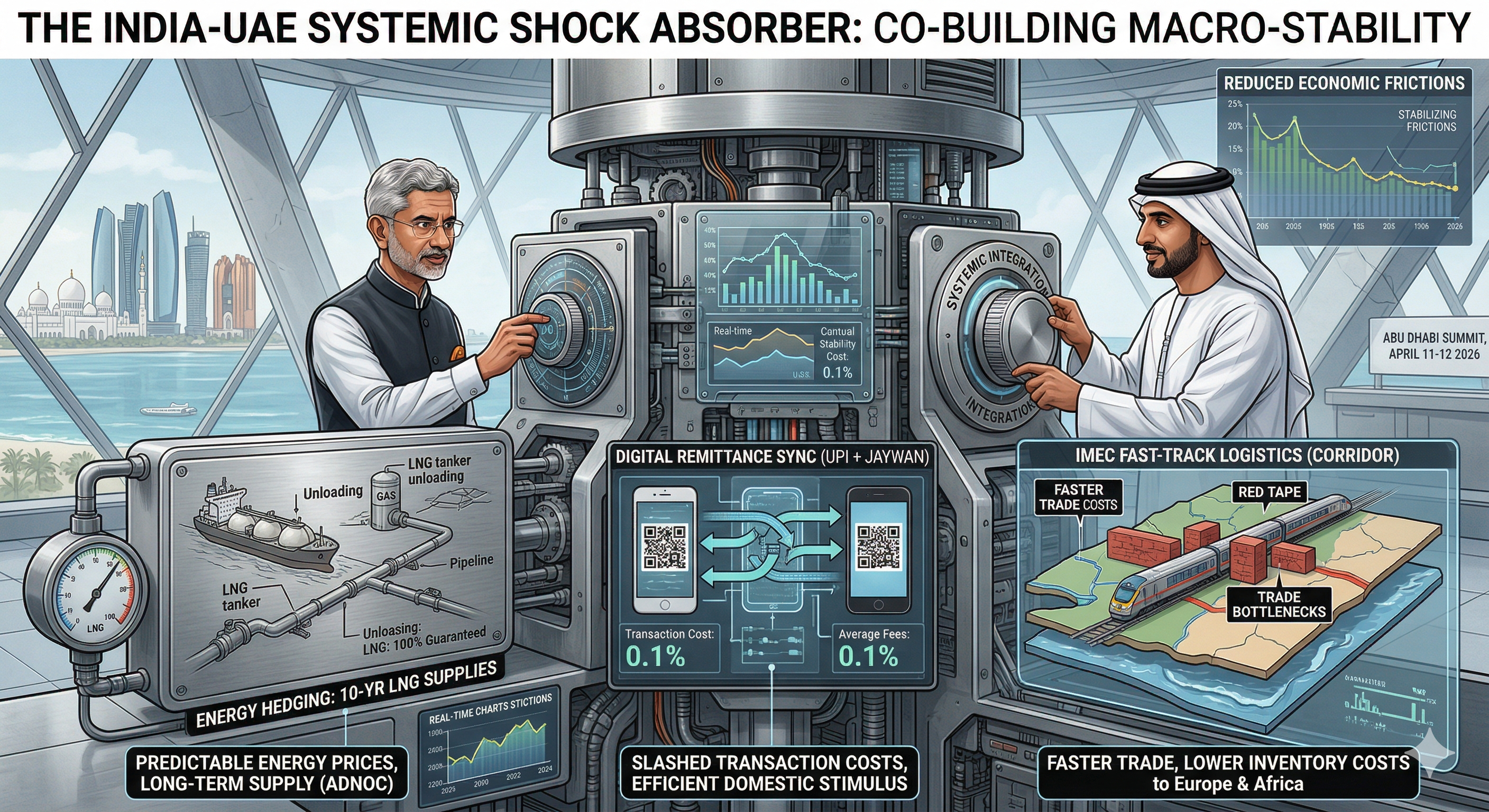
By finalizing long term, 10 year contracts for Liquefied Natural Gas (LNG), India is locking in prices and supply. We are moving from a “buyer and seller” relationship to a “partner” relationship. When India secures a decade of energy at a fixed price, it removes the friction of sudden inflation, giving our industries a stable foundation to grow regardless of regional conflict.
2. Slashing Transaction Costs: The Digital Handshake
One of the biggest hidden taxes on the Indian economy is the cost of moving money.
With over 3.5 million Indians living and working in the UAE, billions of dollars flow back to India every year in remittances. Traditionally, banks and middle men took a massive cut in fees.
The integration of India’s UPI system with the UAE’s JAYWAN network changes the math. By removing these middle men, the “transaction cost” of moving money drops to almost zero. This is a massive stimulus package for the Indian domestic economy. Money that used to disappear into bank fees is now arriving directly in the pockets of Indian families, who then spend it in local markets.
3. The Corridor of Power: IMEC Economics
The most ambitious part of this visit is the push for the India Middle East Europe Economic Corridor (IMEC).
Currently, India’s trade with Europe depends on narrow, crowded shipping lanes that can be blocked by a single accident or a regional war. The UAE is the primary gateway for a new multi modal route that connects Indian ports directly to the heart of Europe via rail and sea.
This is about Trade Diversification. By building this corridor, India is breaking the monopoly of traditional trade routes. It reduces the time it takes to ship goods by 40 percent. In economics, time is money. Faster shipping means lower costs for Indian exporters and cheaper goods for Indian consumers.
4. The MSME Gateway: Bharat Mart
We often think of trade as something only massive corporations do. But this visit is focusing on the small player.
The fast tracking of Bharat Mart in Dubai acts as a physical showroom for Indian micro, small, and medium enterprises (MSMEs). It allows a small manufacturer in Odisha or Haryana to have a global retail presence without the massive overhead costs of international marketing.
By using the UAE as a “re export” hub, Indian small businesses can reach markets in Africa and Europe that were previously impossible to access. This is a structural shift that moves India from being a “local producer” to a “global supplier.”
The Final Bill
Economic friction occurs when uncertainty and high costs stop people from trading.
S. Jaishankar is not just talking about politics in Abu Dhabi; he is actively removing those frictions. By securing energy, slashing transaction costs, and building new trade corridors, India is creating a “strategic interdependence” with the UAE.
In an unstable world, India is finding a stable partner. The goal is simple: ensure that no matter what happens in the global theatre, the Indian economy remains shielded, connected, and growing.
Sources & References
- Ministry of External Affairs (2026): Official briefing on the Strategic Partnership Review in Abu Dhabi.
- Financial Express (2026): “UPI and JAYWAN: How digital integration is boosting Indo-UAE remittances.”
- Economic Times (2026): “Energy Security: India finalizes long term LNG deals with ADNOC.”
- Logistics Weekly (2026): “IMEC Update: The UAE’s role as the gateway to the Europe corridor.”
Subscribe to Economic Frictions
Get independent analysis delivered to your inbox.
Instant unsubscribe link included in every email.
Secure Subscription • One-Click Unsubscribe